

Get in Touch Today
Discover how our copper solutions can enhance your business operations and drive success.
Copper Industry
5 min read
👁️ 118 views

February 14, 2026
Table of Contents
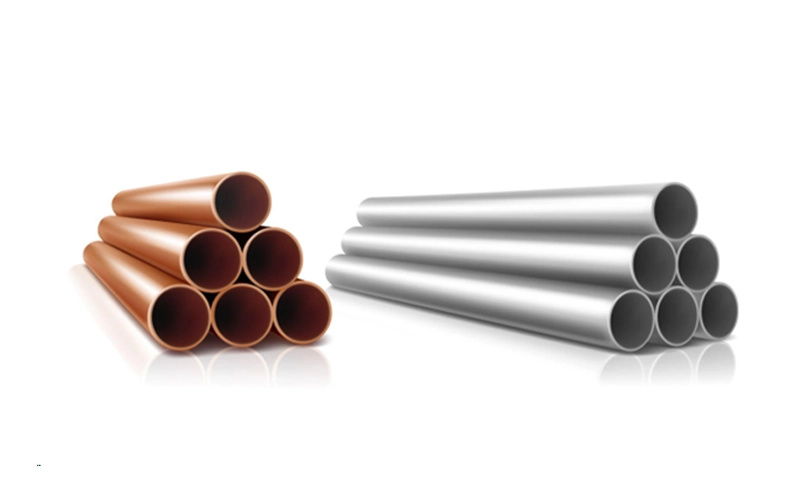
The copper vs. aluminum tubing debate is usually reduced to one figure: the initial price. However, the sticker price is a financial trap.
We have witnessed it many times; projects are delivered at a lower cost, and then a few years later, the system fails disastrously due to the inability of the material to withstand the environment it was used in. It is not only a matter of initial spending. It’s about thermal dynamics, environmental stability, and the total cost of ownership over a 20-year lifecycle. Let’s look at the data.
To understand performance, we have to look at the physics. The fundamental difference between copper vs aluminum pipe starts at the atomic level.
Thermodynamics is unforgiving. If you need to move heat from Point A to Point B, copper is simply the superior conduit.
Standard industrial copper boasts a thermal conductivity rating between 385 and 401 W/m·K. Compare that to aluminum. Depending on the alloy, aluminum typically sits somewhere between 167 and 237 W/m·K.
What does this mean for your operation? It means copper transfers heat nearly twice as efficiently as aluminum. In high-demand systems like refrigeration or industrial cooling, this difference dictates the entire system design. You need less surface area with copper to achieve the same cooling effect.
So, are aluminum coils better than copper in any scenario? From a strict efficiency standpoint, usually no. Because aluminum is less conductive, manufacturers have to compensate. They do this by increasing the surface area or changing the tube geometry.
But there’s a catch.
To get comparable performance, aluminum tubes often need thicker walls to maintain structural integrity. Thicker walls can impede heat transfer. While modern engineering has closed the gap slightly with micro-channel designs, the difference between copper coil and aluminium coil performance remains significant. Why is copper use in heat exchangers? Copper allows for thinner walls with higher strength, maximizing the internal flow area and minimizing the barrier to heat exchange.
This is where the long-term costs begin to show themselves. You may have the most efficient coil in the world, but when it gets a leak in six months, then efficiency is no good.
Copper is naturally defensive. When exposed to the atmosphere, it doesn’t just rust away. It reacts to form cuprous oxide.
Think of this as a shield. This patina is stable, non-destructive, and actually protects the underlying metal from copper tube corrosion. We’ve inspected copper installations that have been running for 50 years with their structural integrity completely intact. It’s a passive survival mechanism that requires zero maintenance.
Aluminum behaves differently. And in many industrial environments, differently means “badly.”
When we analyze copper vs aluminum tubing pros and cons, aluminum’s susceptibility to galvanic corrosion is the biggest negative. If an aluminum tube connects to a brass valve or a copper fitting without perfect isolation, electrolysis begins immediately. The aluminum becomes the sacrificial anode. It eats itself.
Then there’s the issue of environmental exposure. In humid conditions or coastal areas with salt spray, aluminum is prone to pitting. We aren’t talking about surface discoloration. We’re talking about microscopic pinholes that develop from the outside in. These leaks are notoriously difficult to detect and even harder to fix.
Ask any technician about their biggest headache on a job site. They’ll likely point to joining aluminum tubing.
Copper is forgiving. When you braze copper, you aren’t just sticking two pieces together. You’re creating a true metallurgical bond. The capillary action is strong, drawing the filler metal deep into the joint for a seal that is often stronger than the pipe itself.
Using standard phosphorus-copper brazing alloys means you often don’t even need flux (for copper-to-copper joints). It’s clean. It’s fast. A skilled tech can make a leak-proof connection in under a minute. The melting point of copper is high enough ($1,984^\circ F$) that you have a wide safety margin before you risk melting the base metal.
Aluminum is a different animal entirely.
First off, the melting point of the filler metal is terrifyingly close to the melting point of the aluminum tube itself. You have a window of maybe 100 F to work with.
Then there’s the oxide layer. Aluminum oxide melts at a much higher temperature than the base aluminum. This forces technicians to use aggressive chemical fluxes to break down the oxide before brazing. If that flux isn’t perfectly cleaned off (which is hard to do in a tight ceiling crawlspace), it eats through the pipe from the outside.
Industry data suggests that field-installed aluminum joints have leak rates between 8% and 15% higher than copper. That’s not a margin of error. That’s a liability.
Performance isn’t just about material chemistry. It’s about geometry.
In high-pressure HVAC systems, the refrigerant moves fast. If the tube wall varies in thickness, even by a fraction of a millimeter, it creates turbulence. Turbulence creates pressure drops. And pressure drops kill efficiency.
Copper manufacturing allows for incredibly tight tolerances, typically within +-0.002 inches. This precision ensures laminar flow and consistent heat transfer along the entire length of the coil. Aluminum extrusion simply struggles to match this level of consistency without significant cost increases.
Consistency at scale is the real challenge. It’s one thing to make a foot of perfect pipe. It’s another to make a million feet.
This is where production technology dictates quality. The CAST & ROLL technology is used by large-scale manufacturers such as Asteria, which has a facility of 75,000 square meters and a yearly capacity of over 30,000 tons, to ensure uniformity in material specifications. This process is in contrast to the traditional extrusion process, which guarantees that the thickness of the walls is consistent throughout the production lines that are running concurrently with up to 23 product specifications.
When a facility can guarantee that every meter of pipe meets strict international tolerances, the engineer knows the calculated thermal performance will match reality.
You want to install a system and forget about it. That’s the goal.
Copper has what engineers call an “endurance limit.” As long as the stress stays below a certain threshold, copper can theoretically endure infinite cycles without cracking. It flexes without breaking.
Aluminum does not have an endurance limit. It has a finite fatigue life. Every vibration and every thermal cycle uses up a little bit of that life. Eventually, it will crack. It’s not a matter of if, but when.
Let’s be practical for a second. Accidents happen. If it’s copper? You cut out the bad section. You couple it. You braze it. You’re back online in an hour.
If it’s aluminum? You’re likely ordering a new coil. Patching aluminum in the field is technically possible, but rarely successful long-term. Most contractors won’t even warranty an aluminum repair because the risk of a repeat leak is too high.
If you’re a contractor bidding on a project, the pressure to lower the bottom line is immense. And if you’re the facility owner, you want the lowest capital expenditure (CapEx) possible.
When you look at Copper vs aluminum tubing price on a raw material basis, copper is significantly more expensive. Depending on the market fluctuations of the London Metal Exchange (LME), copper can cost 2.5 to 4 times more than aluminum per pound.
That’s a hard number to ignore.
For a large commercial unit, switching to aluminum coils can drop the equipment cost by 15% to 20%. If you are building budget-tier residential AC units or temporary cooling solutions, that margin is everything. It’s why so many entry-level manufacturers have made the switch.
But here’s the other side of the ledger.
The initial savings evaporate the moment you have your first leak. Fixing a copper leak? Standard service call. maybe $300 to $500, depending on refrigerant loss. Fixing an aluminum leak? Usually, you don’t. You replace the coil. Now you’re looking at $1,500 to $3,000 for the part and labor, plus the cost of downtime.
We analyzed maintenance logs from a property management firm in Florida. They found that their aluminum-based units required coil replacements on average every 4 to 6 years. The copper-based units in the same complex? They averaged 12 to 15 years before major service.
When you calculate Copper vs aluminum tubing cost over a 20-year horizon—the typical lifespan of a commercial building—the math changes.
For long-term asset holders, copper is almost always the cheaper option.
Sustainability isn’t just a buzzword anymore. It’s a compliance requirement.
Copper is a special material; it can be recycled indefinitely without performance degradation. The copper pipe you lay today may be copper mined in 1920. By the time that pipe has worn out its usefulness, it still has a high scrap value (usually 80-90% of raw copper prices).
Aluminum is recyclable, sure. But it’s complicated. Because aluminum coils often use different alloys for the fins and the tubes, and because of the brazing contaminants, recycling them is energy-intensive. They often get “downcycled” into lower-grade products rather than being turned back into high-performance tubing.
The most sustainable product is the one that you do not need to replace. By lasting 50+ years in many applications, copper reduces the carbon footprint associated with manufacturing, shipping, and installing replacement parts.
In the Emirates, geography dictates survival.
In Al Ain, the enemy is 50 C heat. Copper’s superior thermal conductivity is critical here for shedding load when ambient temperatures peak.
But in Dubai, Abu Dhabi, or Sharjah? The combination of extreme humidity and salt spray creates a hyper-corrosive environment. We’ve seen aluminum fins on mixed-metal units disintegrate in under 24 months due to galvanic action. The salt acts as an electrolyte, destroying the bond between the aluminum fin and copper tube.
For these coastal zones, copper-to-copper designs (copper tubes, copper fins) are the only viable engineering solution. They eliminate galvanic potential entirely. It’s a higher upfront investment, but it’s often the only setup that survives past the warranty period.
We’ve compiled the technical differences into a direct comparison to highlight the trade-offs between Copper vs aluminum tubing pros and cons.
Feature | Copper Tubing | Aluminum Tubing |
Thermal Conductivity | Excellent (~385–401 W/m·K) | Good (~167–237 W/m·K) |
Corrosion Resistance | High (Forms protective patina) | Variable (Prone to galvanic/pitting) |
Field Repairability | Easy (Standard brazing) | Difficult (Requires specialized flux/skill) |
Tensile Strength | High (Durable under pressure) | Lower (Requires thicker walls) |
Fatigue Life | Infinite (Endurance limit exists) | Finite (Eventually fails under cycle) |
Initial Cost | High | Low (Typically 20–30% less) |
Total Cost of Ownership | Lowest (20+ year lifespan) | Higher (Frequent replacement needed) |
Common Uses of Copper & Aluminum Pipes in HVAC Systems are:
In high-efficiency HVAC units, the difference between copper coil and aluminium coil performance is often the deciding factor for SEER ratings. Copper is the standard for the evaporator and condenser coils because it transfers heat faster. While some manufacturers use aluminum micro-channel coils to cut weight and cost, copper remains the preferred choice for commercial systems where reliability is non-negotiable.
Medical gas systems (oxygen, nitrous oxide, and medical air) almost exclusively use copper. Why? Cleanliness and safety. Copper is naturally antimicrobial and doesn’t release particulate matter. Plus, it can handle the high pressures required by NFPA 99 standards without risking the fatigue failure we see in softer metals.
While steel is common in large mains, copper is frequently used in branch lines for residential and light commercial sprinkler systems. It doesn’t rust like steel, and it resists heat far better than plastic (CPVC).
For hydronic heating and chilled water loops, copper is the workhorse. It can be easily installed in narrow ceiling plenums, and since it forms rigid, waterproof joints, facility managers do not need to be concerned about water damage over sensitive equipment.
Short-Term Focus: If the primary driver is the immediate purchase price, aluminum makes sense. Are aluminum coils better than copper in these specific scenarios? Financially, yes. They get the job done for the lowest possible entry price.
Long- Term: For permanent infrastructure, copper is the only responsible engineering choice.
The choice between copper and aluminum comes down to a balance of performance versus upfront cost. Aluminum offers a lower barrier to entry, making it attractive for budget-constrained applications. However, its susceptibility to corrosion and fatigue limits its lifespan.
Copper, backed by superior thermal conductivity and mechanical strength, remains the professional standard for critical infrastructure. It conducts heat more efficiently, is more durable, and most importantly, can be repaired on the field. Copper offers the lowest total cost of ownership to facility owners who are looking at the 20-year picture.
FAQ
Yes. Copper has nearly double the thermal conductivity of aluminum. This allows copper coils to transfer heat more effectively per square inch of surface area, leading to better overall system efficiency.
Raw aluminum is more abundant and costs significantly less per pound than copper. Additionally, because aluminum is lighter, shipping and handling costs for the raw material are lower, driving down the final component price.
Copper generally lasts significantly longer. It has an infinite fatigue life (meaning it resists vibration damage) and forms a protective oxide layer. Aluminum is prone to fatigue failure and galvanic corrosion, which shortens its service life.
In most environments, yes. Aluminum is highly reactive to galvanic corrosion (when touching other metals) and pitting corrosion in humid or salty environments. Copper is naturally more stable and resistant to these environmental factors.
Latest News | Events

News
5 min read
3 months ago

News
5 min read
3 months ago

News
5 min read
4 months ago

News
5 min read
4 months ago

The Asteria Editorial Team
Copper Industry

https://asteriacopper.com/?p=1196
Link copied


Get in Touch Today
Discover how our copper solutions can enhance your business operations and drive success.