

Get in Touch Today
Discover how our copper solutions can enhance your business operations and drive success.
Copper Industry
5 min read
👁️ 129 views

February 7, 2026
Table of Contents
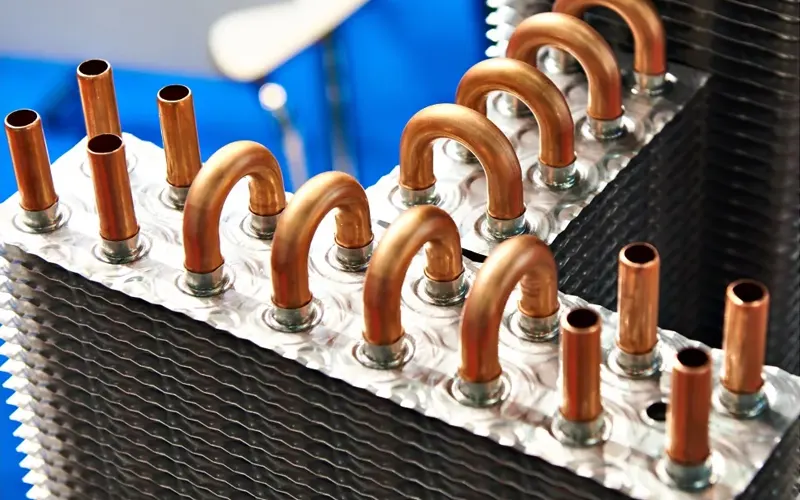
If the compressor is the heart of a cooling system, the heat exchanger is the lungs. It’s where efficiency is defined. For decades, copper used in heat exchangers has remained the industry standard, simply because alternatives like aluminum or stainless steel can’t match its specific trifecta: superior thermal conductivity, natural corrosion resistance, and mechanical workability.
Raw material quality is step one. Manufacturing precision is what determines whether that material performs. Inconsistent wall thickness or surface defects turn tubing into a liability fast.
This is where production scale becomes critical. Large-scale manufacturers, facilities like Asteria Copper Industries, producing 30,000 tons annually, have the systems in place to maintain the tolerances industrial applications require. Bridging the gap between material potential and reliable performance depends on that kind of operational capacity.
Let’s get into the metallurgy. Why does copper work so well? It is simply a matter of the behavior of the atoms.
You’ve probably heard the term copper heat conductivity, but let’s look at what it actually means for your system. At the atomic level, copper has a lattice structure filled with free electrons. These electrons aren’t tied down to a specific atom; they move. Rapidly.
This is where the manufacturing edge matters. At facilities like Asteria, the process starts with high-purity cathode melting in inductive furnaces, ensuring that the chemical composition, specifically phosphorus levels in DHP copper, is tightly controlled to maximize that thermal flow.
Industrial environments are brutal. We’re talking seawater, brine, and chemically treated cooling water.
Copper handles this by forming a stable, protective oxide film on its surface. This natural “shield” resists localized attacks like pitting and crevice corrosion.
However, this resistance relies heavily on two things:
To ensure that this does not occur, manufacturers such as Asteria use surface milling procedures that cut off the outer 0.4 to 1 millimeter of the cast shell. This eliminates any surface oxidation or solidification flaws immediately, and a clean surface is left that will be able to combat corrosion over the long term. Learn more about copper tube corrosion and how to prevent it in our blog post.
The alloy matters, sure. But the shape? Just as important.
You can not go with standard pipe everywhere. The various designs of heat exchangers demand certain geometries to control the flow rates, pressure drops, and the heat transfer surface area.
Copper straight tubes are the workhorses for the air conditioning, refrigeration, and electrical industries.
In these applications, dimensional precision is everything. We’ve seen installations fail because of minor inconsistencies in diameter. If the tube is slightly oval, it won’t seal properly in the tube sheet. If the wall thickness varies, you get uneven pressure handling.
Manufacturers producing at high volumes (Asteria handles 23 simultaneous product lines) focus heavily on straightness and concentricity here. The goal is a tube that slides perfectly into a chiller bundle or fits seamlessly into a busbar system.
For Original Equipment Manufacturers (OEMs), speed is money.
If you are running a mass production line making HVAC copper tubing or coils, you don’t want to stop every 10 minutes to load a new coil. Level Wound Coils (LWC) are continuous lengths of seamless tubing designed exactly for this.
The benefits are twofold:
Think of this as the metering device of the cooling world.
It controls the flow of refrigerant into the evaporator. It’s a throttle. If the internal diameter is off by even a fraction of a millimeter, the system’s pressure balance is ruined.
Precision here is non-negotiable. Manufacturing copper capillary tubes requires 100% Eddy Current testing to catch even the smallest non-uniformities or blockages. It’s detailed work, but essential for system efficiency.
Sometimes, you need flexibility; literally. Copper pancake tubes are typically annealed (softened), which allows technicians to bend and form the tubing on-site without it kinking. They are the go-to for repairs, fuel gas lines, and difficult routing in residential AC installs.
Standard tubing is great. But “great” doesn’t always meet modern energy efficiency standards.
To get more cooling power out of the same footprint, the industry turned to inner grooved copper coils.
The concept is clever. In a smooth tube, fluid tends to flow in layers (laminar flow). The layer touching the wall moves slower, creating a “boundary layer” that acts like insulation.
Grooves machined into the inner surface disrupt that flow. They create turbulence.
This turbulent flow breaks up the boundary layer and mixes the refrigerant, ensuring more of it touches the metal wall. The result?
Producing these isn’t easy. The groove depth (0.1mm to 0.30mm) and the apex angle (40° to 65°) must be exact. Advanced lines use specialized grooving machines to ensure those features are uniform along every single meter of the tube.
We often get asked: “Why not just use aluminum? It’s cheaper.”
And yes, aluminum is cheaper. But in heat exchangers, you usually get what you pay for. When comparing heat transfer copper vs aluminum, the performance gap is stark.
Copper transfers heat roughly 60% better than aluminum. And compared to stainless steel? It’s nearly 30 times higher.
Property | Copper | Aluminum | Stainless Steel |
| Thermal Conductivity | ~400 W/m·K | ~235 W/m·K | ~14 W/m·K |
| Corrosion Resistance | Excellent (Marine/Biofouling) | Moderate (pH sensitive) | Excellent (Chemical) |
| Workability | Excellent (Easy brazing) | Fair (Harder to repair) | Difficult |
| Biofouling | High (Antimicrobial) | Low (Fouls readily) | Low |
Here’s the financial reality: The cost of the copper tube is a tiny fraction of the Total Cost of Ownership (TCO) of an industrial system.
Imagine saving 10% on cheaper piping for a power plant condenser. Now imagine that plant shutting down for three days because a tube leaked. You’ve just lost 100 times what you “saved.”
Investing in high-quality copper reduces TCO in two ways:
Reliability isn’t an accident. It’s engineered.
At a facility like Asteria’s, quality control happens at every single step, not just at the end.
When a manufacturer adheres to standards like ASTM B280, B111, and EN 12735-1, they aren’t just following rules—they are de-risking your project.
For facility managers, contractors, and engineers, the data is clear.
While alternative materials have their place in niche applications, copper heat exchanger designs offer the only comprehensive balance of thermal performance, longevity, and workability. The physics, those free electrons moving through the lattice, provide an efficiency advantage that translates directly to the bottom line.
But remember, the material is just the canvas. The art is in the manufacturing.
It is either the accuracy of a capillary tube or the turbulence-creating geometry of an inner grooved pipe, but the manufacturing process determines the performance. The sophisticated production techniques such as the Cast and Roll technology that the industry leaders have adopted will see to it that the copper tubing you install today will see your systems running smoothly decades to come.
In the world that is pursuing decarbonization and green energy, the efficiency of copper is not a mere technical choice, it is a functional requirement.
Latest News | Events

News
5 min read
3 months ago

News
5 min read
4 months ago

News
5 min read
4 months ago
News
5 min read
4 months ago

The Asteria Editorial Team
Copper Industry

https://asteriacopper.com/?p=1186
Link copied


Get in Touch Today
Discover how our copper solutions can enhance your business operations and drive success.