

Get in Touch Today
Discover how our copper solutions can enhance your business operations and drive success.
Copper Industry
5 min read
👁️ 2894 views

December 15, 2025
Table of Contents
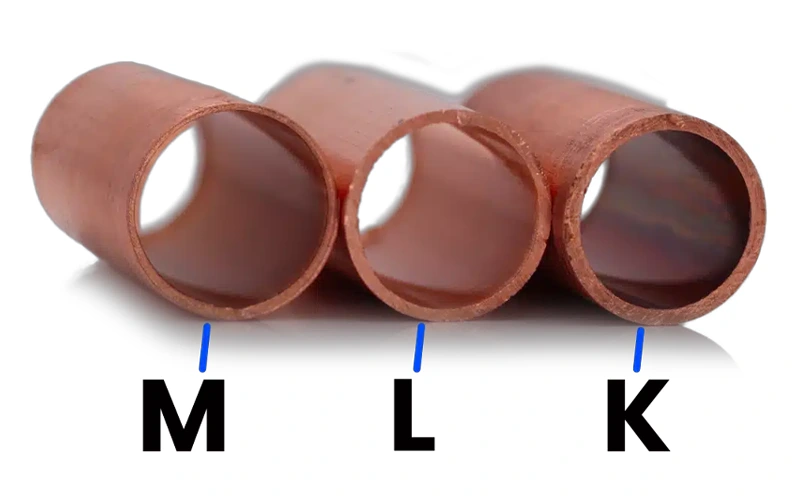
Copper pipe types represent standardized categories that define thickness, pressure tolerance, and intended applications in residential and industrial plumbing. The plumbing sector uses Type K, L, and M because each provides a different balance of strength, durability, and cost efficiency. Selecting the correct type is essential for pressure safety, long-term performance, and project budgeting. Builders, contractors, and homeowners rely on these classifications to specify systems accurately. For a clearer understanding of Type M copper vs type K vs L, read this guide on Asteria Copper Industries.
Type K copper pipe is defined as the thickest and most pressure-resistant copper pipe grade in the ASTM B88 standard, and its international market price generally ranges from USD 6 to 12 per foot depending on diameter. This pipe type is designed for demanding underground, industrial, and high-pressure applications. It delivers exceptional longevity in chemical environments and is widely used in municipal water distribution.
Type K copper also supports installation in pump lines, fire protection systems, and oxygen delivery networks due to its superior structural integrity. This specification is often chosen when reliability outweighs cost sensitivity, especially in large-scale infrastructure work.
Here is Technical Specifications Table of Type K Copper:
Property | Value |
| Nominal Sizes (in.) | ¼ to 2 |
Wall Thickness (in.) | 0.035–0.083 |
| Operating Pressure (psi) | 400–1,200 |
Burst Pressure (psi) | 1,000–3,000 |
| Typical Weight (lb/ft) | 0.12–0.95 |
Market Range (USD/ft) | 6–12 |
| Type K copper pipe used for | Underground water lines, fire systems |
Type L copper pipe is defined as the mid-grade copper tube used for residential and commercial plumbing, and its international market price typically falls between USD 4 and 9 per foot. It maintains a strong balance between durability and cost efficiency for pressurized indoor applications. Contractors prefer Type L for interior water distribution, hydronic heating, and moderate-pressure cooling lines. This pipe grade performs well in structural environments exposed to occasional vibration or thermal cycling. Its versatility makes it the default choice for many building projects.
To understanding Technical Specifications of Type L Copper, see below Table:
Property | Value |
| Nominal Sizes (in.) | ¼ to 2 |
Type L copper pipe thickness | 0.030–0.070 in. |
| Operating Pressure (psi) | 300–1,050 |
Burst Pressure (psi) | 900–2,700 |
| Typical Weight (lb/ft) | 0.09–0.78 |
Market Range (USD/ft) | 4–9 |
| What is Type L copper pipe used for | Indoor water supply, HVAC lines |
Type M copper pipe is defined as the most cost-effective thin-wall option in the copper-tube family, and its international market price generally ranges from USD 3 to 6 per foot. This pipe is suitable for low-pressure residential applications where budget constraints drive selection.
Builders frequently use Type M for domestic cold-water lines, vent piping, and certain hot-water distribution systems where local codes permit. Although not suited for extreme pressure, it is reliable for everyday household plumbing. Its lightweight profile simplifies installation and reduces transportation costs.
Here’s Technical Specifications Table of Type M Copper:
Property | Value |
| Nominal Sizes (in.) | ¼ to 2 |
Wall Thickness (in.) | 0.025–0.058 |
| Operating Pressure (psi) | 200–850 |
Burst Pressure (psi) | 650–2,000 |
| Typical Weight (lb/ft) | 0.07–0.56 |
Market Range (USD/ft) | 3–6 |
| What is type M copper pipe used for | Low-pressure residential lines |
Type L and Type M copper pipes differ primarily in wall thickness, pressure performance, and long-term durability. Type L is designed for moderate-to-high internal pressure, while Type M is intended for cost-efficient, low-pressure installations. This distinction directly affects system lifespan, corrosion resistance, installation cost, and suitability for municipal code requirements. The comparative performance also influences specification decisions in environments with mechanical vibration or chemical exposure. Many residential projects use Type M, whereas commercial applications often default to Type L.
In market analysis, Type L generally carries a higher cost per foot because of its thicker construction and improved pressure rating. Type M provides a more affordable solution but should be chosen only when the application’s pressure and temperature conditions fall comfortably within its limits. The selection must also account for local regulations, as some regions prohibit Type M for certain potable water systems. Understanding the trade-offs helps prevent premature failures and unexpected repair costs. These considerations are essential when assessing Type L copper vs type M as part of project planning.
Here’s a Comparison Table of Thickness, Pressure Rating, Durability, Price per Foot:
Attribute | Type L | Type M |
| Thickness | 0.030–0.070 in | 0.025–0.058 in |
Type L vs type M copper pipe pressure rating | 300–1,050 psi | 200–850 psi |
| Durability | High | Moderate |
Price per foot | USD 4–9 | USD 3–6 |
Type L is recommended for interior water distribution systems, pressurized HVAC loops, and commercial plumbing where durability outweighs material cost. Type M is appropriate for budget-focused residential plumbing, venting lines, and low-pressure hot-water circulation where regulations allow it. The decision also depends on local municipal code, expected system lifespan, and exposure to mechanical stress.
Type K, L, and M copper pipes differ noticeably in functional performance, particularly when evaluated under real operating conditions. These variations become more apparent when comparing overall pressure stability, installation flexibility, and interaction with different jointing systems. Type K remains the strongest, Type L provides balanced performance for daily plumbing operations, and Type M is optimized for affordability without compromising basic safety.
This performance comparison becomes especially important in long-term planning where system longevity and maintenance requirements must be forecast. Understanding these distinctions helps clarify the practical implications behind Type M copper vs type K, Type L copper vs type K, and Type L copper vs type M during specification.
Here’s Performance Comparison Table:
Feature | Type K | Type L | Type M |
| Pressure Capacity (psi) | 400–1,200 | 300–1,050 | 200–850 |
Approximate Lifespan (years) | 70–100 | 60–90 | 40–70 |
| Compatibility with Fittings | Excellent (all soldered, brazed, compression) | Excellent (all soldered, brazed, compression) | Good (mainly soldered and compression) |
Type L vs type M copper pipe pressure rating | In column L | In column M | |
| Type l copper vs type m size | In column L | In column M | |
Type K copper | In column K | — | — |
Choosing between the three grades requires a complete assessment of mechanical load, environmental exposure, installation method, project budget, and system longevity targets. Every application has conditions that favor one pipe type over another, meaning a contractor must balance performance characteristics with regulatory limits and long-term operating costs.
The decision becomes especially important when evaluating Type M copper vs type K, optimizing budgets through Type L copper vs type K, or identifying mid-range solutions using Type L copper vs type M. A high-pressure line may require Type K, while an indoor potable system may favor Type L, and cost-driven home projects often select Type M. The best outcome always results from applying a structured evaluation approach.
Check this Application Selection Checklist:
A final comparison helps contractors and engineers map project conditions to the correct pipe grade. This table consolidates the engineering factors that influence selection, providing a structured view for balancing cost, performance, and compliance. It also clarifies how the three grades differ in practical use-case alignment.
Here’s a Comparative Selection Table:
Factor | Type K | Type L | Type M |
| What is Type K copper pipe used for | High-pressure, underground | — | — |
What is Type L copper pipe used for | Residential/commercial interiors | In column L | — |
| What is type M copper pipe used for | Low-pressure home lines | — | In column M |
Preferred Environment | Underground, industrial | Indoor plumbing | Budget residential |
| Expected System Life | Maximum | High | Moderate |
Regulatory Use | Widely approved | Widely approved | Restricted in some regions |
Proper safety and maintenance practices significantly extend the lifespan of copper piping systems, especially in environments that impose thermal or chemical stress. These measures prevent unexpected failures, support regulatory compliance, and maintain pressure integrity throughout the system’s service life. The items below include factors not mentioned in earlier sections and ensure thorough preventive care.
Please check these Important Safety and Maintenance Notes:
Selecting the correct pipe grade depends entirely on system pressure requirements, environmental conditions, regulatory limits, and cost expectations. Understanding the distinctions between Type K, Type L, and Type M helps clarify which option offers the best balance of durability, performance, and investment value. This article answered the core question by mapping technical, operational, and economic considerations across all three grades. To place an order, customers may visit the Asteria website and submit their request directly on this page. They can either call the provided phone numbers or click the orange “Send a Request” button at the bottom and enter their details so our team can follow up.
FAQ
Use Type L when you need higher pressure tolerance, a longer lifespan, and broader code approval. Type M is appropriate for low-pressure indoor applications where local regulations permit and where budget efficiency is a priority.
Compressed air systems generally require Type L because it offers the safest balance of pressure capacity and durability. Type M is not recommended due to its thinner walls and lower surge-handling capability.
Type K has the thickest walls and the highest pressure tolerance, making it suitable for underground and industrial systems. Type L is a versatile mid-grade option used in most interior plumbing applications. Type M has the thinnest walls and is intended for low-pressure residential use.
Latest News | Events
News
5 min read
3 months ago

News
5 min read
9 months ago

News
5 min read
9 months ago

News
5 min read
10 months ago

admin
Copper Industry

https://asteriacopper.com/?p=820
Link copied


Get in Touch Today
Discover how our copper solutions can enhance your business operations and drive success.