

Get in Touch Today
Discover how our copper solutions can enhance your business operations and drive success.
Copper Industry
5 min read
👁️ 2260 views

December 8, 2025
Table of Contents
Understanding the mechanical behavior of copper tubing is becoming increasingly vital in modern industrial design. According to global manufacturing reports, more than 62% of copper tube failures originate from improper tubing selection; specifically, choosing between hard drawn copper pipe and soft (annealed) copper. If installers or engineers overlook the hardness, temper, or manufacturing process behind copper tubes, the consequences can include pressure loss, structural fatigue, long-term leakage, unexpected maintenance costs, and reduced equipment life. This article explains these differences in detail; particularly the difference between hard-drawn copper and annealed copper; to help you make the right decision for system efficiency, durability, and safety.
For complete technical guidance about Hard drawn vs soft copper pipe, follow this article on the Asteria Copper Industries blog.
A precise understanding of the terminology behind copper manufacturing is essential before comparing hard drawn vs soft copper pipe. Each of these terms governs mechanical behavior, pressure tolerance, formability, hard drawn and soft copper pipe dimensions, and long-term system performance. A misinterpretation can lead to incorrect assumptions about hard drawn and soft copper pipe size, affecting installation decisions, lifecycle expectations, and even hard drawn or soft copper pipe cost evaluations.
Annealing is a heat-treatment process that reduces internal stresses in copper. By heating and slowly cooling the metal, it becomes softer, more flexible, and easier to bend. This process transforms hard-drawn tubing into its soft, highly formable state.
Temper refers to the hardness level achieved through mechanical or thermal processing. Tempers for copper pipes usually range from fully annealed (O temper) to hard-drawn (H temper), each affecting application compatibility and hard drawn vs soft copper pipe pros and cons.
Hardness
Hardness represents the metal’s resistance to deformation. Hard-drawn copper has significantly greater hardness due to the absence of final-stage annealing, which influences hard drawn and soft copper pipe price, installation difficulty, and structural performance.
Copper drawing is a cold-working procedure where copper is pulled through a die to reduce diameter and increase length. Every pass through the die strengthens the copper by increasing dislocation density. Repeated cold drawing without heat recovery makes the copper progressively harder. This is why the difference between hard-drawn copper and annealed copper originates primarily from the final heat-treatment phase; or the lack of it.
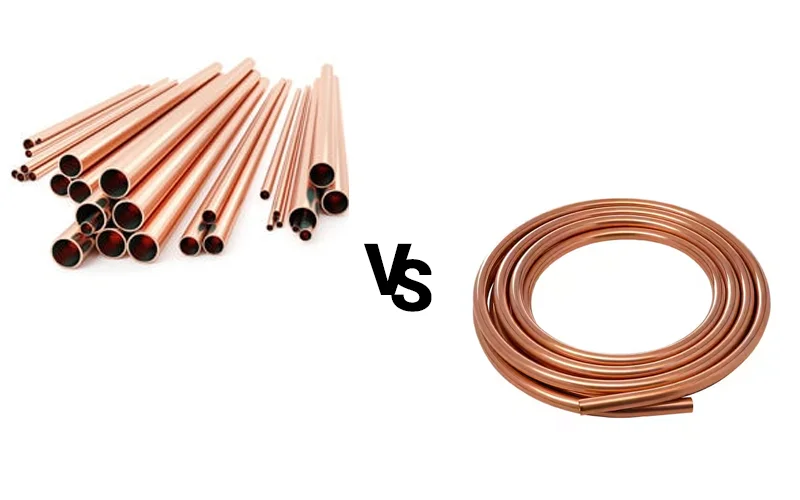
Hard-drawn copper tubing is produced through repeated cold drawing without annealing in the final stage. This process generates high tensile strength, rigidity, and stability under pressure. Engineers select hard drawn copper pipe for systems requiring minimal flex, high structural reliability, and dimensional accuracy. Because it is stronger, it affects hard drawn or soft copper pipe cost, offers clear hard drawn and soft copper pipe pros and cons, and fits applications where bending is minimal. Understanding what is hard drawn copper is a prerequisite to selecting the correct tubing for industrial and HVAC environments.
Hard-drawn tubing exhibits enhanced mechanical performance. Before listing the characteristics, it is essential to highlight that these features directly influence hard drawn vs soft copper pipe price, installation strategies, and dimensions in large systems.
Key characteristics include:
Hard-drawn copper pipes are selected for installations where stability, alignment accuracy, and vibration resistance matter. This widens the range of hard drawn or soft copper pipe pros and cons for engineering teams who must match tubing characteristics to system requirements.
Primary applications include:
Below is the professional technical table required for system design and assessing hard drawn and soft copper pipe dimensions, ensuring compliance with performance standards.
Specification Category | Hard-Drawn Copper Value |
| Tensile Strength | 250–300 MPa |
Yield Strength | 220–260 MPa |
| Hardness (HV) | 80 –110 HV |
Temper Classification | H58 / Hard |
| ASTM Standard | ASTM B88, ASTM B280 |
Pressure Rating | Up to 1200 psi |
| Diameter Range | 1/8″ to 4″ (standard) |
Wall Thickness | Types K, L, M available |
Soft-drawn (annealed) copper tubing is heat-treated after drawing to restore ductility and flexibility. This process creates the opposite characteristics of hard-drawn tubing, making it ideal for installations requiring bending, coiling, and vibration absorption.
Understanding the flexibility of soft-drawn copper helps engineers determine the difference between hard-drawn copper and annealed copper, as well as evaluate hard drawn vs soft copper pipe pros and cons, installation costs, and suitable environments. Its ease of forming influences both hard drawn and soft copper pipe cost and long-term maintenance considerations.
Soft-drawn copper is known for its bendability and ease of manipulation. Before listing its characteristics, note that these traits make a significant difference in hard drawn vs soft copper pipe size selection, particularly in confined spaces or complex layouts.
Here are key characteristics of Soft Drawn:
Soft-drawn copper is preferred in systems where layout adaptability and ease of installation outweigh structural rigidity. These use cases illustrate the operational aspect of hard drawn vs soft copper pipe pros and cons.
Here are some crucial and primary applications:
Soft-drawn (annealed) copper follows strict dimensional, temper, and performance standards to ensure optimal flexibility, pressure handling, and long-term system reliability. Understanding these specifications is essential because coil form, wall-thickness accuracy, and ASTM classifications directly influence compatibility, installation requirements, and operational safety.
| Specification Category | Soft-Drawn Copper Value |
| Tensile Strength | 150–200 MPa |
| Yield Strength | 45–90 MPa |
| Hardness (HV) | 45–65 HV |
| Temper Classification | O60 / Annealed |
| ASTM Standard | ASTM B88, B280, B75 |
| Pressure Rating | 400–700 psi |
| Diameter Range | 1/8 to 1″ (coils) |
| Wall Thickness | Types K, L, M available |
Choosing between these two tempers requires a deep understanding of mechanical performance, installation complexity, lifecycle expectations, and long-term functional stability. Engineers often compare hard drawn and soft copper pipe pros and cons to determine suitability for pressure systems, bending requirements, vibration conditions, and pipeline geometry. These factors directly influence hard drawn or soft copper pipe cost, their dimensions, and overall system reliability. Without a proper evaluation, selecting the wrong tubing can increase maintenance costs and interfere with design tolerances.
Here’s Comparison Table about Hard Drawn + Soft Copper Pipe Pros and Cons:
Feature / Factor | Hard-Drawn Copper Pipe | Soft (Annealed) Copper Pipe |
Flexibility | Low | Very high |
Pressure Resistance | Very high | Moderate |
Installation | Requires soldering and precise alignment | Easy bending, suitable for tight spaces |
Durability | Excellent under vibration | Good, but less stable under high pressure |
Lifecycle Maintenance | Low | Moderate |
Cost Impact | Slightly higher upfront | Lower initial cost |
Typical Use Cases | HVAC, industrial, medical gas, long straight runs | Residential water lines, A/C coils, complex routing |
Formability | Poor | Excellent |
Dimensional Stability | Very high | Moderate |
Bending Tools Required | Heavy-duty tools | Basic bending tools |
Selecting between these two temper types depends entirely on system behavior, environmental conditions, and installation constraints. Engineers consistently assess hard drawn or soft copper pipe size, allowable stress limits, and route complexity before deciding. Meanwhile, technicians consider how hard drawn and soft copper pipe dimensions influence fitting requirements and tool compatibility.
There is no universal winner. Hard-drawn copper pipe is better for high-pressure, long-distance, and vibration-intensive systems, while soft copper pipe is superior for flexible routing and confined installations. Deciding which is better depends on hard drawn vs soft copper pipe cost, pressure ratings, and the degree of required formability.
The following considerations can guide engineers:
The selection also affects tools and installation equipment:
Cost evaluation must consider more than initial purchase price. The hard drawn and soft copper pipe price difference is affected by temper, manufacturing steps, coating requirements, wall thickness, and certification standards. While hard-drawn copper pipe may cost slightly more upfront due to its extended cold-working cycles, soft copper pipe may incur additional costs for fittings and protective routing.
Key cost-related insights include:
The difference between hard-drawn and soft copper is rooted in temper, mechanical strength, and installation behavior. Hard-drawn copper provides rigidity, high pressure tolerance, and dimensional stability, while soft-drawn copper offers unmatched flexibility and ease of bending. To answer the main question; What is the difference between hard drawn and soft drawn copper? It is essentially the contrast between strength and flexibility, each suited for distinct environments.
If you are ready to place an order, you can easily submit your request directly through the Asteria Copper Industries website. Simply call our support numbers or click the orange “Send a Request” button at the bottom of this page and provide the required details so our team can contact you promptly.
FAQ
Hard copper pipe is rigid, strong, and designed for high-pressure straight installations. Soft copper pipe is annealed, flexible, and suitable for bending and coiled installations. The mechanical difference comes from annealing: hard copper is cold-drawn, while soft copper is heat-treated to restore ductility.
Hard-drawn copper is used in commercial HVAC, industrial refrigeration, medical gas lines, high-pressure systems, and long straight runs where rigidity and precise alignment are essential.
Soft-drawn copper is used in residential water lines, A/C coils, underground services, tight-space bends, gas lines, and any system requiring adaptable routing without rigid joints.
Latest News | Events

News
5 min read
3 months ago

News
5 min read
9 months ago

News
5 min read
9 months ago

News
5 min read
10 months ago

admin
Copper Industry

https://asteriacopper.com/?p=794
Link copied


Get in Touch Today
Discover how our copper solutions can enhance your business operations and drive success.